Last-Mile Delivery Optimization: Solving Urban Logistics With AI
Last-mile delivery is simultaneously the shortest and most expensive segment of the supply chain. AI route optimization is helping logistics teams transform urban delivery economics — reducing cost per stop, improving delivery density, and cutting carbon emissions.
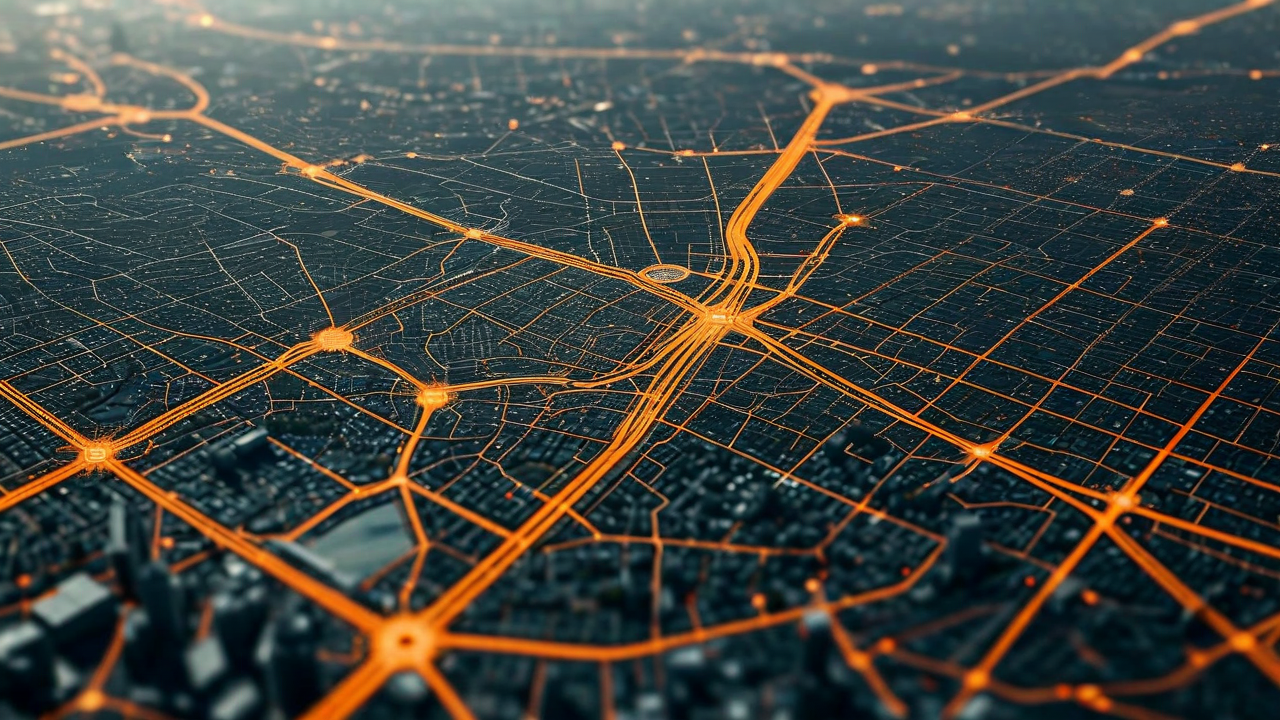
Last-mile delivery — the final leg of a shipment's journey from a distribution hub to its destination — accounts for 41-53% of total supply chain costs despite typically covering a small fraction of total distance. This cost concentration is driven by the density problem: instead of moving large volumes efficiently between two points, last-mile logistics requires coordinating hundreds of small deliveries across densely populated areas with unpredictable access conditions, variable delivery success rates, and tight time windows.
The rise of e-commerce has made this problem dramatically more acute. When consumers expect two-day or same-day delivery, the logistics economics of last-mile become even more challenging: delivery windows are tighter, stop densities are harder to achieve, and the cost of failed deliveries and redeliveries is magnified. For retailers and logistics service providers alike, last-mile efficiency is increasingly a competitive differentiator rather than merely an operational consideration.
The Economic Structure of Last-Mile Costs
Understanding why last-mile is so expensive requires understanding the cost drivers at the stop level rather than the shipment level. Most last-mile cost models are driven by four key variables: stop density, service time per stop, failed delivery rate, and vehicle utilization.
Stop density is the most powerful cost lever available to last-mile operators. A delivery route with 30 stops in a tight geographic cluster is dramatically more cost-efficient than a route with 30 stops spread across a wider area, even if the total distance driven is similar. Density determines how much productive work (successful deliveries) is accomplished per unit of driver time and vehicle capacity. Routes with high stop density typically have a cost per delivery that is 40-60% lower than routes with comparable stop counts but low density.
Service time per stop encompasses everything from parking and access to the delivery point, to the physical handoff time, to any customer interaction required. In dense urban environments, access and parking time can dominate service time. A driver who has to circle a block twice to find parking and then navigate a multi-tenant commercial building adds 8-10 minutes per stop to their route — a significant time cost across a 20-stop day. Route planning systems that model access and service time variability by delivery location type and urban zone produce significantly more accurate time windows and better route sequencing.
Failed delivery rate — the percentage of stops where the recipient is not available and a redelivery attempt is required — directly inflates cost per successful delivery. Industry data suggests average failed delivery rates of 8-12% for B2C deliveries, rising to 15-20% in some dense urban markets. Each failed delivery attempt consumes driver time, fuel, and vehicle capacity without generating revenue. Predictive availability modeling — using machine learning to identify the time windows when each delivery location is most likely to have an available recipient — can reduce failed delivery rates by 20-35%.
How AI Transforms Last-Mile Route Optimization
Traditional route planning tools for last-mile logistics apply vehicle routing algorithms to minimize total distance or drive time subject to time window and capacity constraints. These tools work reasonably well in stable, well-modeled environments. They struggle in the highly dynamic, data-rich environment of modern urban last-mile logistics.
AI route optimization for last-mile differs from traditional VRP approaches in several important ways. First, it learns from historical delivery performance at the address and zone level. If a specific delivery address has historically required 12 minutes of service time rather than the default 5-minute assumption, an AI system learns this and incorporates it into routing calculations. If a specific delivery zone has high failed delivery rates between 9 AM and 11 AM but low rates after 2 PM, the system learns the optimal time window assignment for that zone. This address-level and zone-level learning produces more accurate route plans than any static model can achieve.
Second, AI route optimization handles real-time dynamic re-optimization in a way that static VRP tools cannot. When a delivery driver encounters an unexpected road closure, a failed delivery at a stop, or a late addition to the route, the system can recalculate the optimal remaining sequence instantly, incorporating the actual current state of the route rather than replanning from scratch. This dynamic re-optimization capability can recover 15-25% of the performance losses that traditional routing systems absorb when routes deviate from plan.
Third, machine learning models for last-mile routing can incorporate a much richer feature set than traditional algorithms — traffic pattern data at the time-of-day and day-of-week level, parking availability data by zone, building access constraints, historical carrier performance on specific stops — that make route plans significantly more reliable in execution.
Integration With Middle-Mile Strategy
Last-mile optimization does not exist in isolation from the broader supply chain. The economics of last-mile are significantly affected by middle-mile network design decisions — where distribution centers are located, how inventory is positioned, and how consolidated versus dispersed the final-mile handoff points are. AI-powered supply chain optimization increasingly treats middle-mile and last-mile as a unified optimization problem rather than separate systems.
Micro-fulfillment strategies — placing small inventory positions in urban locations closer to end customers — directly improve last-mile density by reducing the distance from fulfillment point to delivery destination. AI modeling of demand patterns, delivery density maps, and real estate costs can identify the optimal micro-fulfillment locations to maximize last-mile efficiency for a given urban market.
Carrier selection for last-mile delivery has also become more sophisticated with AI support. Different last-mile carriers — regional parcel carriers, national carriers, gig-economy delivery platforms, USPS/postal services — have very different cost and performance profiles depending on delivery zone, package characteristics, and time window requirements. AI routing platforms that model carrier performance at the zone level can recommend the optimal carrier mix for a given delivery batch, significantly reducing cost per delivery compared to single-carrier approaches.
The RouteBrain platform connects last-mile routing intelligence with the broader supply chain optimization framework, enabling companies to make routing decisions that optimize across the full delivery cost stack — not just the final leg in isolation.
Sustainability and Last-Mile Emissions Reduction
Urban last-mile logistics is a significant contributor to urban emissions and congestion. Delivery vehicles circling blocks, making multiple attempts at failed deliveries, and operating on inefficient routes contribute to urban air quality problems and add to traffic congestion in already-stressed urban environments. For logistics companies and their retail customers, reducing last-mile emissions is increasingly a business priority as well as an environmental one — driven by customer expectations, regulatory pressure, and corporate sustainability commitments.
AI route optimization reduces emissions through the same mechanism it reduces cost: fewer miles driven per delivery, higher stop density, fewer failed delivery attempts, and better vehicle utilization. For companies tracking their Scope 3 emissions, last-mile route optimization is one of the most impactful levers available for reducing supply chain carbon footprint.
Electric vehicle integration is the next frontier in sustainable last-mile logistics. AI routing platforms that incorporate EV range and charging requirements into route planning — ensuring routes are designed to work within EV battery parameters with appropriate charging stops — will be essential for logistics operators as they transition their last-mile fleets to electric. This requires routing algorithms that model energy consumption by route segment rather than assuming constant energy cost per mile, which is standard in EV range planning.
Measuring Last-Mile AI Impact
Several metrics provide clear visibility into the impact of AI optimization on last-mile performance. Cost per delivery — the total last-mile operating cost divided by successful deliveries — is the primary economic KPI. Stops per hour measures driver productivity directly and is the main operational driver of cost per delivery. First attempt delivery rate tracks successful delivery on the first attempt without redelivery. On-time delivery rate measures performance against promised delivery windows. Route accuracy measures how closely actual routes match planned routes — high divergence indicates either planning quality issues or execution variability that the system needs to learn from.
For companies implementing AI last-mile optimization, benchmarking these metrics before and after implementation provides the clearest picture of ROI. Most implementations see cost per delivery reductions of 10-20% and first-attempt delivery rate improvements of 15-25% within the first 90 days of deployment, with continued improvement as the system accumulates address-level and zone-level learning over time.
Key Takeaways
- Last-mile delivery represents 41-53% of total supply chain costs and is the primary logistics cost lever for e-commerce and direct delivery businesses.
- Stop density, service time accuracy, failed delivery rate, and vehicle utilization are the four key cost drivers in last-mile economics.
- AI route optimization improves on traditional VRP tools through address-level learning, real-time dynamic re-optimization, and richer feature sets including traffic, parking, and access data.
- Middle-mile network design and last-mile optimization should be treated as a unified AI problem rather than separate systems for maximum cost efficiency.
- Route optimization is one of the most impactful levers for reducing last-mile emissions and supports electric vehicle fleet integration as EV adoption increases.
- Cost per delivery reductions of 10-20% and first-attempt delivery rate improvements of 15-25% are typical outcomes from AI last-mile optimization implementations within 90 days.
Conclusion
Last-mile delivery is one of the most complex and high-impact optimization problems in logistics. AI is making meaningful inroads into the economic challenge — reducing cost per delivery, improving delivery success rates, and lowering emissions through more efficient routing. For companies managing significant last-mile volumes, AI optimization is rapidly becoming a table stakes capability rather than a differentiator.
RouteBrain's last-mile capabilities are integrated with our broader supply chain intelligence platform, providing a unified optimization view from origin to doorstep. Reach out to our team to discuss how AI routing can improve your last-mile economics.